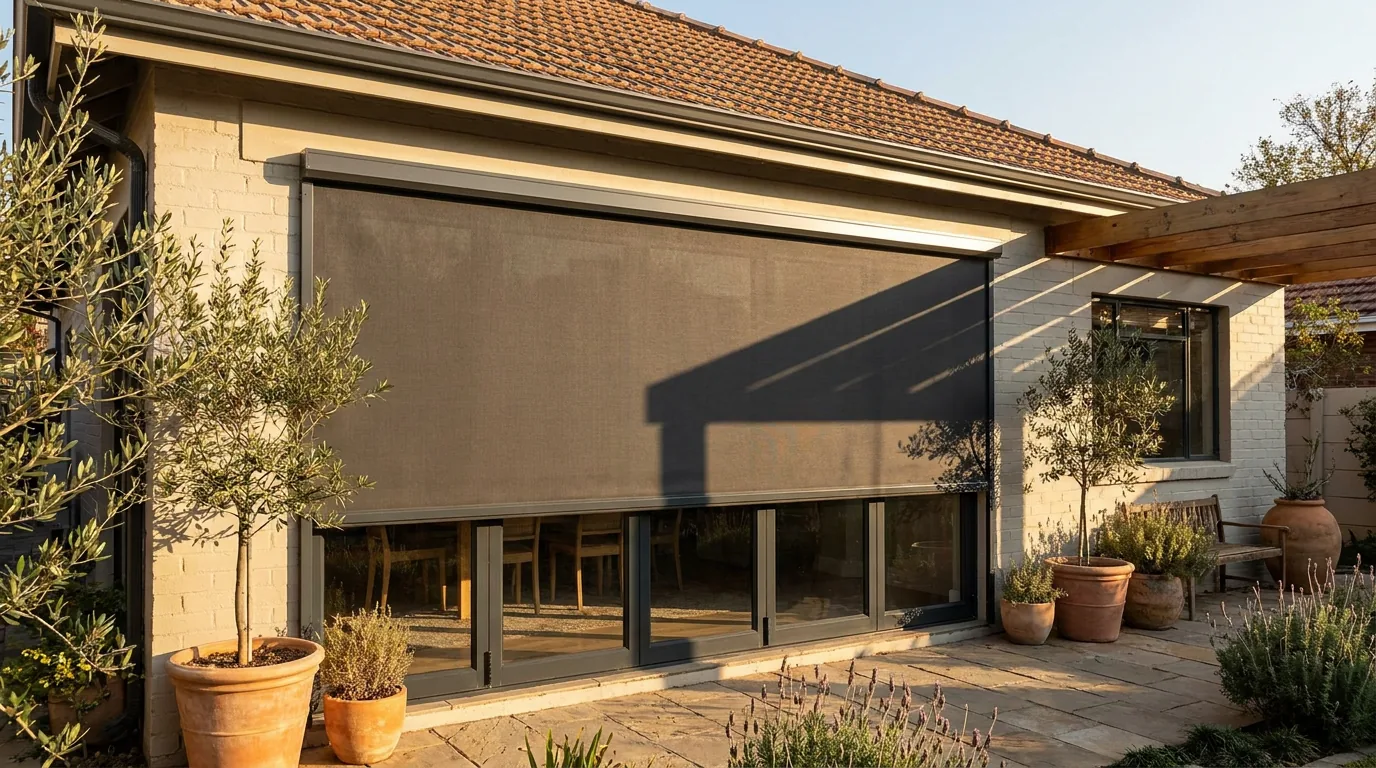
An exterior zip screen lowered two thirds of the way across the glass stacking doors of a renovated Parkhurst cottage extension, late afternoon sun raking across the courtyard paving

Home  /  The Three O'Clock Book

A free guide · Parkhurst, Johannesburg

The Parkhurst Three O'Clock Book

Where the sun actually goes over a Parkhurst stand, what it does to the front cottage and the glazed box behind it, and what we would fit at each window — including where we would spend nothing at all.

Free to read · no sign-upSources listed at the footAbout a nine-minute read

Chapter one

Two houses, one address.

Parkhurst was laid out in 1904 — 2,200 stands carved off the old Braamfontein farm. A third of it was built by the 1930s and the rest finished after the Second World War, and gentrification has been rebuilding it since the 1960s.

That history explains almost everything that happens at the windows here. The street face is small, low and old: steel casements, narrow sashes, deep reveals in solid brick, Edwardian and Tudor Revival details. The back of the same house is often fifty years newer, because the standard Parkhurst move is to gut the rear, throw a glazed box at the garden and then live almost entirely in it.

The front of the house is a proportion problem. The back is a heat problem. They want opposite answers.

At the front there is little glass and little heat, but a great deal of character to ruin with the wrong bulky headrail. At the back there is a wall of glass facing a small garden, on a stand narrow enough that the neighbour's kitchen is part of the view — and by three o'clock in February that beautiful room is the hottest in the house.

So we quote most Parkhurst houses as one project with two specifications. What follows is what we look at while we do it.

Chapter two

The light here, in numbers.

Two figures decide more about your windows than any fabric ever will.

Johannesburg sits at 26°11′ south and 1,753 metres up. On the December solstice the midday sun climbs to roughly 87.2° — within three degrees of straight overhead — and the day runs 13 hours 47 minutes. On the June solstice it tops out at about 40.4°, and the day is only 10 hours 30 minutes long.

That 47-degree swing is the whole game. A device that saves you in January is often precisely the wrong device in June, which is why almost nothing we specify here is fixed and permanent.

The second number is direction. In midsummer the sun rises at a bearing of 116° — south of due east — and sets at 243°, south of due west, arcing high through the northern sky in between. In midwinter it rises at 69° and sets at 295°, spending the whole short day low in the north.

Then there is the weather your outdoor gear has to survive. Summer brings daily afternoon thunderstorms from November to March, and nearly all of the 713 mm of annual rain with them. Hail runs October to March and peaks in November; Gauteng's severe-storm activity peaks in October and November. Winter is the reverse: dry, sunny days, then nights around 4 °C with occasional frost.

Altitude adds one more thing. The Highveld's height and its cloudless skies produce genuinely high ambient ultraviolet: the WHO's guide puts UV levels 10 to 12% higher for every 1,000 metres of altitude, and Johannesburg sits 1,753 of them up. That is why a west room here fades a rug faster than the same room at the coast, and why the fabric you hang is doing real work rather than decoration.

One local mercy: Johannesburg's northern suburbs carry far more urban forest than the south — 24.2% against 6.7% — and Parkhurst's streets are properly treed. On some windows the right specification is nothing at all, because a plane tree already does the job. We would rather tell you that than sell you a blind.

21 Dec · 87.2° Equinox · 63.8° 21 Jun · 40.4° Room Eave Garden — north →
  • 21 Dec at 87.2° — the eave shades the whole wall
  • 21 Jun at 40.4° — sun reaches about a metre into the room
Noon, north elevation Same eave, opposite results

Not sure which way your rooms face? Stand at the back door at four o'clock in summer — if the sun is in your eyes, that wall is west, and it is the one worth spending on first.

See what we'd fit

Chapter three

Elevation by elevation, on a narrow stand.

Four walls, four completely different problems — and only one of them is really about heat.

North — easy, if you keep it adjustable

At 87° overhead in December, even a modest eave shades a north wall at midday. In June the sun is at 40° and comes from exactly this direction, so north glass is where free warmth arrives on a 4 °C morning. The mistake is fitting something permanent: a fixed screen that rescues you in January quietly costs you every evening in July.

We'd specify: retractable or tiltable — an awning, venetians, a sunscreen roller you can raise.
West — the wall the whole suburb complains about

Through a summer afternoon the sun tracks down toward 243°: low, and pointed straight at the glass. An overhang cannot help, because the sun is underneath it. If your rear extension faces west, that is why the room empties at three o'clock — and it is the one elevation where we argue hard for stopping heat outside the glass rather than managing it inside.

We'd specify: exterior first — zip screens or roller shutters, then an interior blind for glare and evening privacy.

East — the same problem, cheaper hour

Summer sunrise at a bearing of 116° puts low sun into east bedrooms not long after five. The house is cold when it happens, so the complaint is glare and being woken, not heat accumulating all day — which makes this an inexpensive wall to fix, and one where an interior blind is entirely adequate.

We'd specify: blockout rollers or venetians, inside the reveal, no exterior spend needed.

South — no heat at all, but cold at night

Because midsummer sunrise and sunset both sit south of the east–west line, a south wall catches direct sun only at the ends of the longest days and effectively none the rest of the year. The light is lovely and glare-free. What these rooms do have is single glazing losing heat all night through a Highveld June.

We'd specify: insulation rather than shading — cellular blinds, closed at dusk.

Overhead — the renovation skylight

Roof glass takes the December sun almost perpendicular at noon, with no wall angle to soften it — which is why the room somebody built for light so often becomes the hottest in the house by January.

We'd specify: tensioned side channels, and almost always a motor — nobody adjusts a blind they cannot reach.

The village side — privacy on the same window

On 2,200 stands packed into 1.64 square kilometres, the shading window and the privacy window are usually the same window. Sunscreen fabric that behaves beautifully by day turns you into a lit stage set after dark.

We'd specify: day/night blinds, or a dual roller — sunscreen by day, blockout at night, one bracket.

Chapter four

What we'd fit, and the honest catch with each.

Every one of these is wrong somewhere. Tap add on anything that sounds like your house and it will be waiting on the form at the foot of this page.

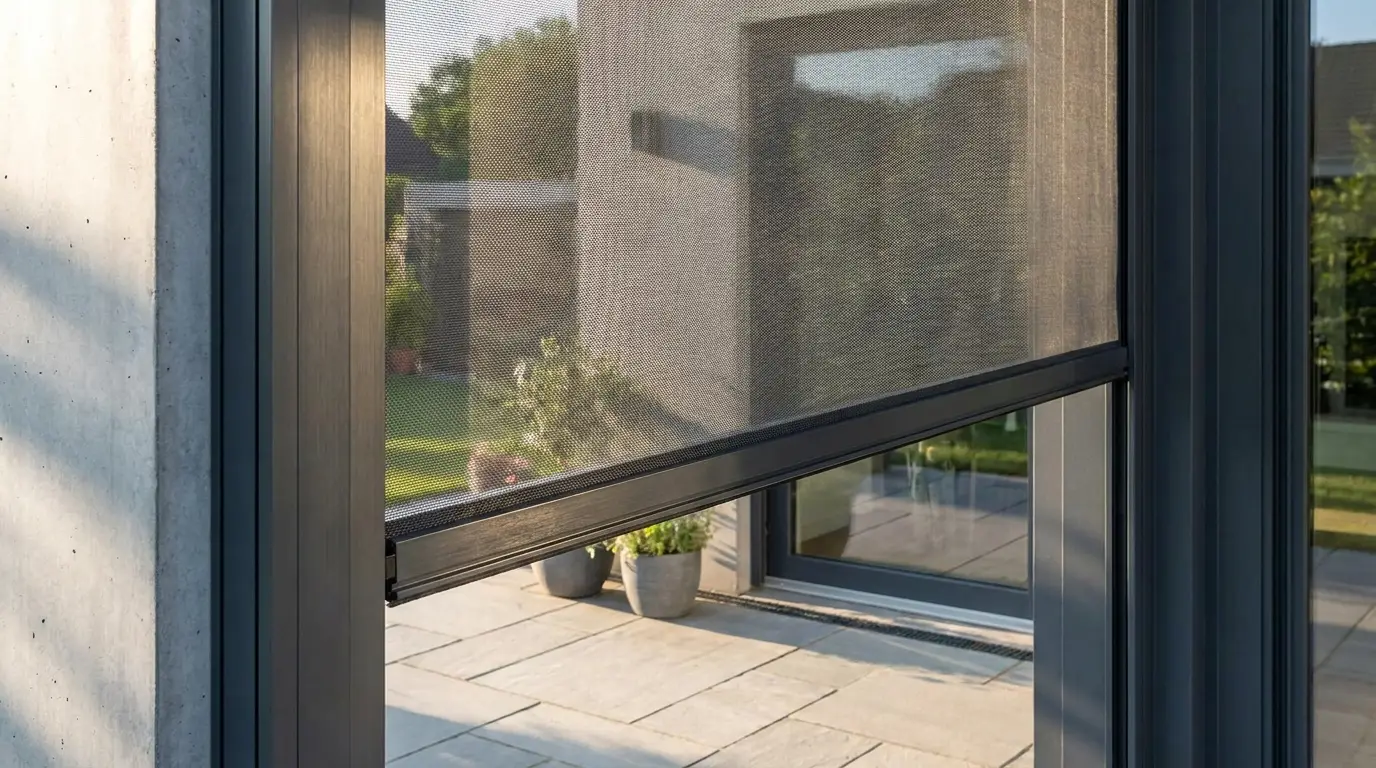
Close-up of an exterior zip screen mesh held taut in its slim aluminium side channel, morning light on the fabric weave and hardware track

Zip screens — the answer for the back of the house

Best on: west and north stack doors, courtyards, the glazed rear box

Why here. Mesh held drum-tight in zipped side channels, outside the glass — so it stops the sun before the pane. An interior blockout roller on the same doors darkens the room beautifully while the glass behind it goes on radiating heat at you. You keep the garden view, and the insects stay out.

The catch. The channels are hardware fixed to the outside of the house, so the heritage question below applies, and the mesh greys the view slightly. On an exposed opening through hail season we would specify a motor and wind sensor over a cheaper manual screen.

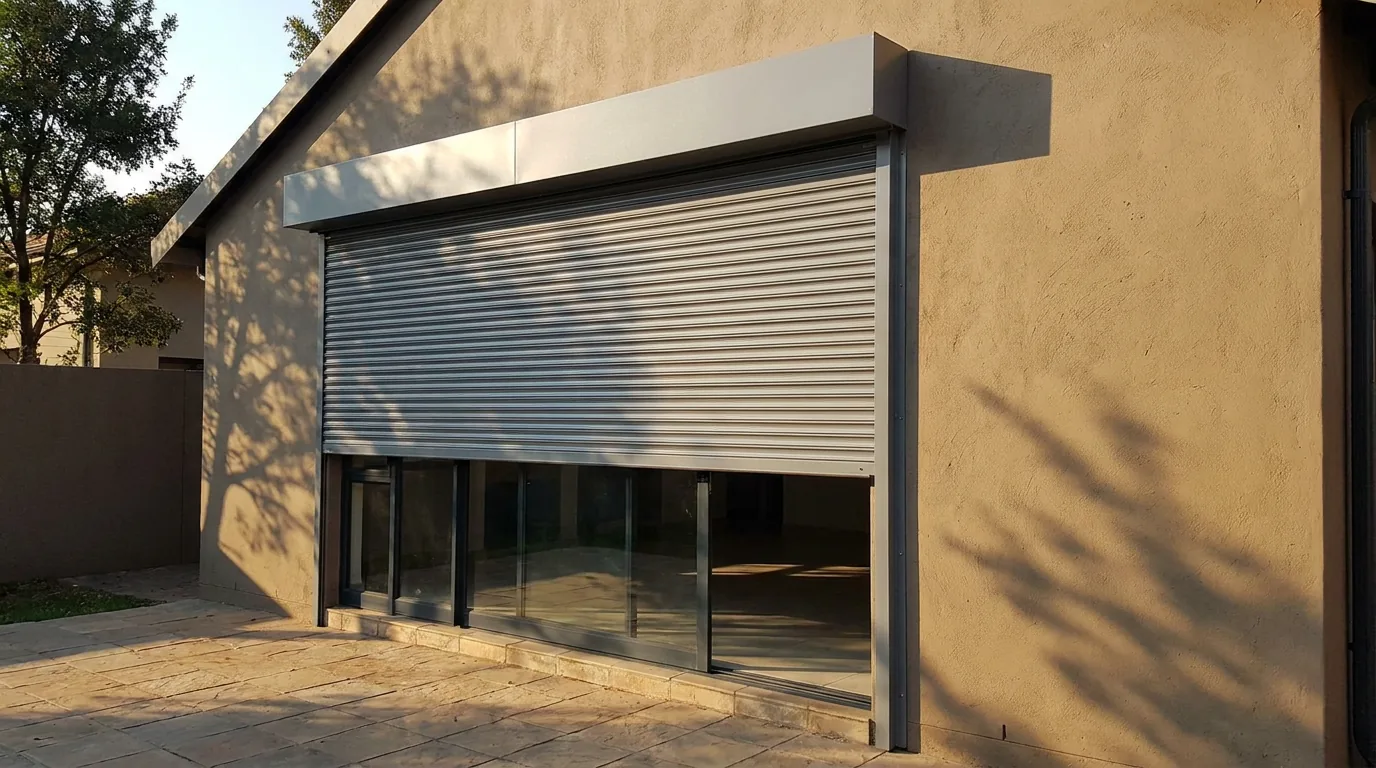
External aluminium roller shutter with rigid slats part-lowered over a glazed sliding door on the west side of a house

Roller shutters

Best on: a punishing west elevation, the new rear wing

Why here. Rigid aluminium slats rolling down outside the glass: the heaviest-duty way to stop sun, heat and glare, with blackout privacy when fully closed. On a west wall in February nothing else does as much.

The catch. The headbox and rails are visible architecture and read as unmistakably modern on a 1940s street face, so we keep them for the rear. And plainly: these are shading shutters, not security-rated shutters — a different product, available on request. We will never imply a shading shutter secures your home.

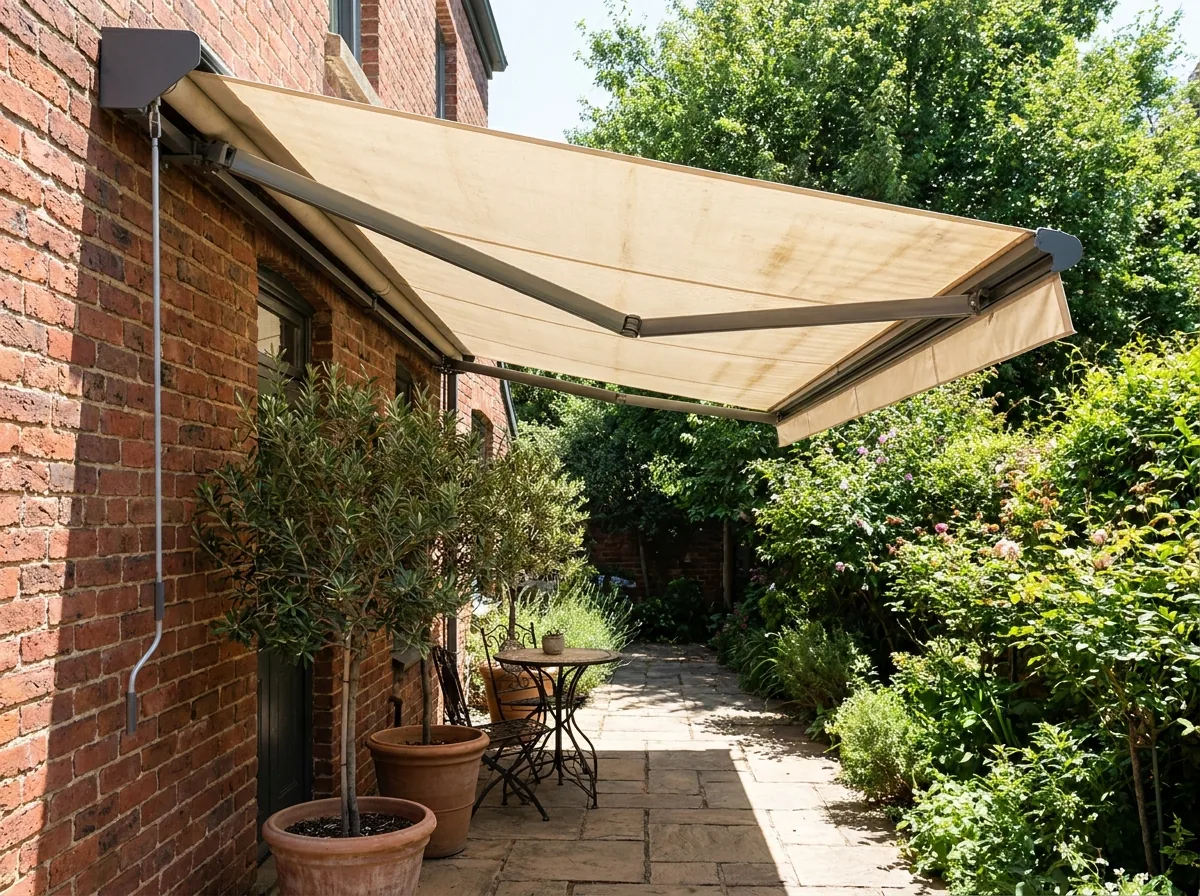
Folding-arm awning cantilevered over a narrow paved courtyard behind an old brick cottage, no posts on the ground

Folding-arm awnings

Best on: the courtyard, the stoep, the north side of a small garden

Why here. An awning shades the table with nothing standing in the way of it, which is why it beats a fixed pergola on a narrow stand. It also folds away — and on a north courtyard that matters, because you want the 40° June sun back.

The catch. One caught open in a November gust does not survive it, so we would rather quote a motor and a wind sensor than a manual arm you must remember while you are out. The cassette is wall-fixed, so heritage applies here too.

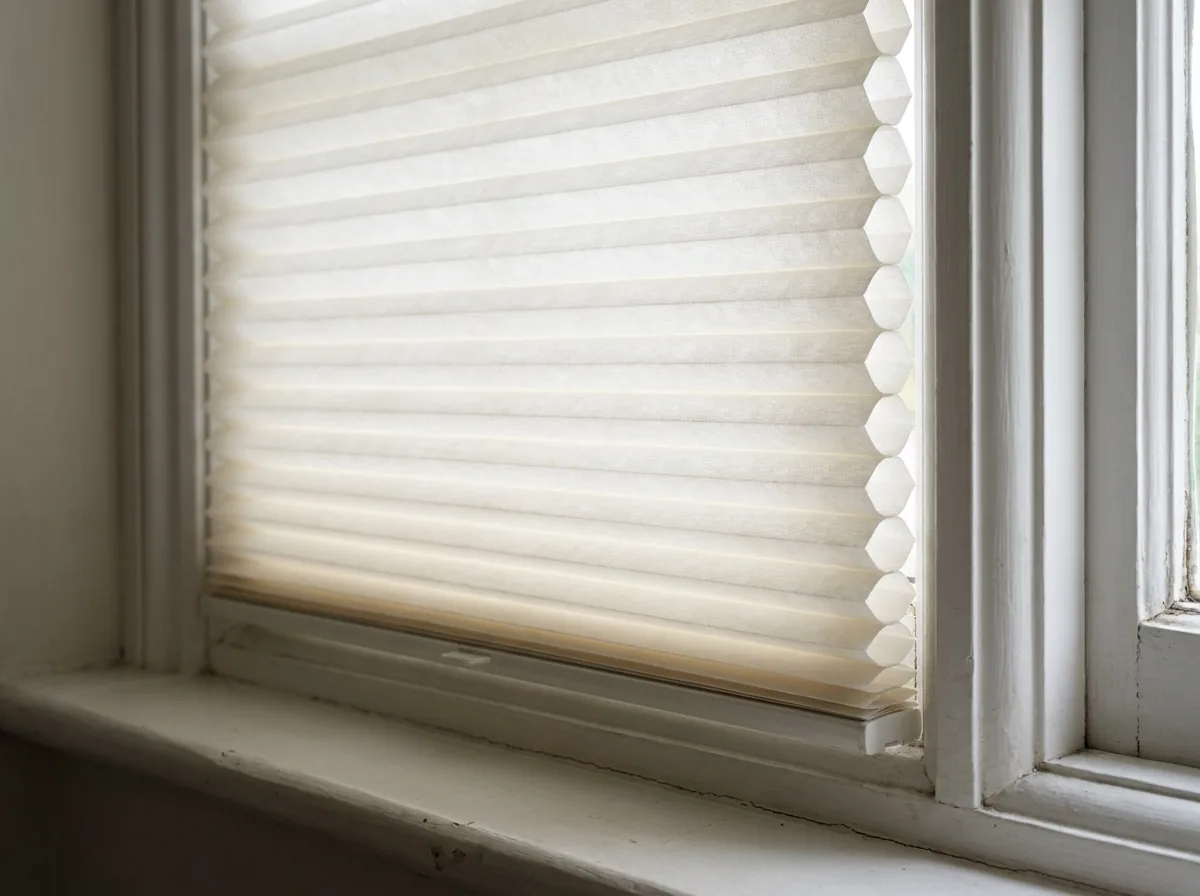
Cellular honeycomb blind showing its rows of hexagonal air cells at the edge of a small white-painted cottage window

Cellular / honeycomb blinds

Best on: original steel casements, south rooms, front bedrooms

Why here. Honeycomb cells trap still air against the glass — the quiet answer to a single-glazed 1940s window on a 4 °C June night. Slim stack, sits inside a shallow reveal, leaves the steel frame doing its architectural work.

The catch. It does not tilt: light is on or off, with none of the in-between a venetian gives you. It is fabric, so a steamy bathroom is the wrong room — that one goes to aluminium.

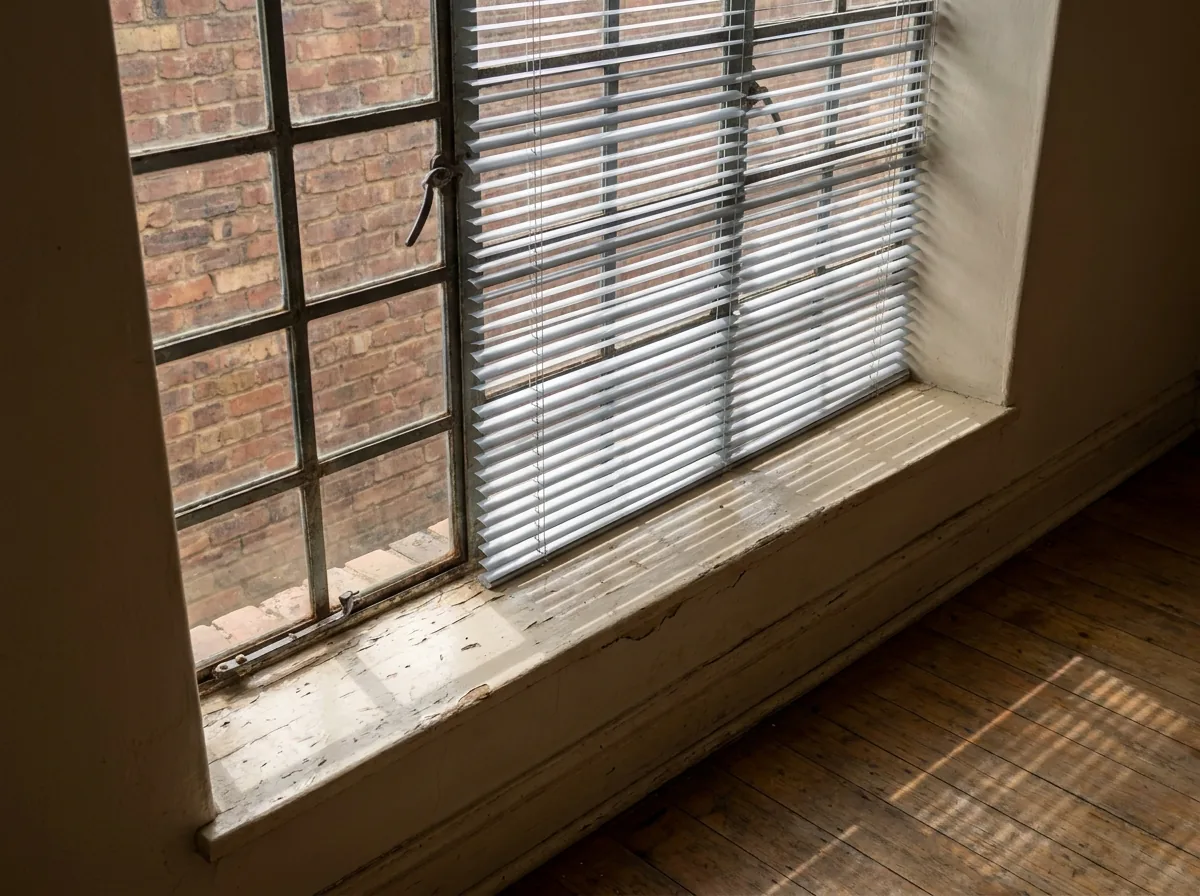
Slim aluminium venetian blind fitted inside the reveal of an original steel-framed casement window, slats tilted so light falls in bars across the sill

Venetian blinds, aluminium and timber

Best on: east bedrooms, kitchens and bathrooms, the character rooms at the front

Why here. Tilt is control, and no other blind has it: lay the morning light down across the floor instead of throwing it into somebody's eyes, then close for privacy without going dark. 25 mm aluminium for steel casements and wet rooms; 50 mm basswood for the front rooms.

The catch. Slats need dusting, timber stays out of bathrooms, and on a really wide opening one venetian gets heavy to lift — we would split it in two rather than sell you something you resent operating.

Roller blinds — sunscreen and blockout

Best on: garden-facing living rooms (sunscreen), every bedroom (blockout)

Why here. One smooth flat panel on a tube, no folds. Sunscreen keeps the garden view while cutting glare and taking the UV; blockout does the bedrooms properly. Both hang on one dual bracket at the same window, which on a Parkhurst stand is usually the answer.

The catch. Sunscreen gives no privacy after dark — a lit room is perfectly visible from the pavement, and on these streets that matters. Blockout alone means choosing between the view and the dark. For one blind only, look at day/night.

Day/night blinds

Best on: street-facing rooms, narrow side windows, anywhere the neighbour is close

Why here. Alternating sheer and solid bands in one blind: line them up for privacy, offset them and the view returns. In a suburb built at this density it settles shading and privacy at one window with one fitting.

The catch. More moving parts than a plain roller, and not a true blackout — a sliver of light still reads at the band edges. For a nursery we would still put a blockout roller behind it.

The wide, the high and the hidden

Best on: stack-door walls, skylights, gables, and extensions still on paper

Why here. Vertical vanes rotate and stack right off a wide sliding door. Panel blinds do the same job on a ceiling track and look calmer doing it. Skylight and shaped blinds run in tensioned side channels so fabric stays flat overhead. A concealed box hides the headbox in a ceiling recess.

The catch. Verticals are the least designed-looking thing we fit; panels need wall to stack into, which a small extension may not have; and a concealed box is a building decision — simple while the ceiling is open, a builder's job afterwards.

Motorisation & automation

Best on: skylights, stairwell windows, wide spans, children's rooms, anything outdoors

Why here. A blind nobody can reach is a blind nobody adjusts, and an unadjusted blind is just a dark room. Outdoors a wind sensor retracts the awning before the storm arrives, home or not. It also removes cords entirely — the safest arrangement in a nursery.

The catch. Motors need power, and a cable route that does not chase an original 1940s wall is a real question in a house this age. Battery motors dodge that and hand you a charging routine you have to keep.

Optional

Want this Book marked up for your own house?

Tell us which rooms are the problem and we will send it back with notes against your actual elevations — which of the answers above we would start with at your address, and which we would leave well alone. No visit involved, and no obligation to book one.

We use these details only to send you the marked-up Book and, if you ask for it, to arrange a consultation call-back (POPIA). No marketing lists, and never shared with a third party.

Chapter five

The sixty-year question, and a committee that meets fortnightly.

Parkhurst was founded in 1904 and finished building out after the Second World War. That makes effectively every original cottage here older than sixty years — and age alone is the trigger, not a plaque and not a listing.

Section 34(1) of the National Heritage Resources Act 25 of 1999 says no person may alter or demolish any structure, or part of a structure, older than sixty years without a permit from the relevant provincial heritage resources authority — in Gauteng, PHRA-G.

There is a live local step as well. PRABOA — the Parkhurst Residents' and Business Owners' Association, a member of the Johannesburg Heritage Foundation since 2023 — runs a Building Control subcommittee that meets every two weeks. Owners are asked to put intended plans for alterations, including as-built structures never approved, to PRABOA before submitting anywhere else; applications that skip that step come back as incomplete.

That draws a clean line through this Book. Blinds fitted inside a room touch neither the structure nor the way the house reads from the street. Anything mounted outside — roller shutters, a wall-fixed awning cassette, face-fixed zip channels — does.

We fit blinds and are not heritage practitioners, so we will not tell you what the answer will be for your address. We will raise it at the measure before anything is ordered, and design the interior specification so you have a good option either way.

Chapter six

Five things only a tape measure at the window can settle.

This is the honest limit of any guide, including this one. Everything above narrows the field. These five decide it — and they are exactly what the free measure is for.

  1. True reveal depth, and whether the opening is square

    Eighty years of settling leaves casements out of square, and reveals vary wall to wall inside one room. Depth decides whether an inside mount is possible at all, which decides how much light escapes past a blockout at the edges. We measure in three places, never one.

  2. What the frame is made of, and what it will carry

    Steel casement, meranti and modern aluminium each take a fixing differently, and some old timber is either too soft or frankly too good to drill. Then we mount into the surrounding masonry instead — but only once we have put a hand on it.

  3. How exposed that elevation really is

    Anything external lives or dies on wind exposure through an October-to-March storm season. A courtyard tucked behind a gable and one thrown open to the west are different specifications — sometimes different products altogether.

  4. Where the power for a motor can actually go

    Motorising a skylight or a wide span is simple in principle and fiddly in an old cottage: the cable has to arrive without chasing an original wall. Sometimes the roof void solves it in ten minutes; sometimes the honest answer is a battery motor.

  5. What the street trees and the neighbour's wall already do

    A fair share of the afternoon shade in Parkhurst is already free. Knowing which windows need no spending at all is worth as much as knowing which do — a judgement made standing in the room at four o'clock in February, not read off a plan.

All five take a tape measure and ten minutes at the window. That is the entire reason the measure exists — and the entire reason it is free rather than something we charge you to find out.

Book the free measure

Chapter seven

Two ways forward — and one of them costs you nothing but a knock at the door.

Recommended

The free expert measure & written quote

A consultant comes to you with fabric and slat samples, walks the elevations at the hour that actually matters, measures every opening properly, and leaves a written quote itemised per window so you can keep, cut or phase any line of it. Free, and no obligation at the end of it.

Five or six of these a week is our real capacity across Parkhurst and the streets around it, so the diary tends to fill early in the week.

Book my free measure

Optional

Want a ballpark first?

Pop in rough sizes and we will send a budget range by the next working day. Not sure how to measure? Leave it out — our consultant measures for free either way, and that is where the exact per-window pricing comes from.

Open the window ledger

The close

Book your free expert measure.

One short form. If you would also like a budget range, add rough window sizes underneath it — that part is entirely optional, and nobody will chase you for it.

  • Every opening measured individually — 1940s frames are rarely square
  • Samples brought to you, judged in your own light
  • Repairs and single windows are welcome, not just whole houses
  • The heritage question raised before anything is ordered

Book your free expert measure

Anything you added from the Book above is already ticked below.

What you're interested in (tick as many as you like)
Optional: add rough window sizes for a budget range

Rough really is fine — a tape across the outside of the frame is enough for a range, and we will send that range by the next working day. And if measuring is not your idea of a Saturday, skip this entirely: the free measure gives you exact per-window pricing anyway.

Your window ledger — room, width, drop, mount and product for each window
Room Width (mm) Drop (mm) Inside or outside the reveal Product Remove

Nothing on the ledger yet — and that is completely fine.

Your details are used only to arrange this consultation call-back and, if you have added sizes, to send your budget range. They are never shared with any third party (POPIA).

Sources

Where the numbers on this page come from.

Every sun-path, climate, canopy, heritage and history figure above is taken from the following. Where a figure was disputed or could not be verified, we left it out rather than round it into a sentence.

The full research pack behind this page, including the facts we could not verify and deliberately left out, is kept with our own notes. Ask the consultant for it at the measure and we will happily walk you through it.